Thursday, 15 February 2018

Wednesday, 14 February 2018
CHANGE IS COMING.
Kenya is at a crossroads and we the people are terrified. That is why we lash out at each other at the slightest hint of provocation. It is not really hate that is so pervasive on social media. It is fear. Fear of the unknown that expresses itself as hate for the Other.
We know that what we have is not really working, at least not for the vast majority of us. We are lost, but we have no one to show us our way home. We are in a dark place and we dare not take another step forward lest we fall into the abyss.
So, in our paralysis, we continue calling each other names in the dark, instead of reaching for one another's hand and feeling our way together, however tentatively, forward until we find the light of day.
But we are in a kairos moment for our nation. A moment of rebirth and we must summon up the courage to push until the new Kenya is born.
However, we must be careful. For there are all manner of people pretending to be midwives but whose actual motive is to carry out Pharaoh's orders to snuff out the new life before it takes its first breath.
So, let us beware of the custodians of the old order - the politicians, the diplomats, some church leaders, business people, civil society - who are desperate to hide from us the fact that we are at a moment of rebirth and who would substitute a version of the old Kenya for the new one we so long for.
The old is truly dying; the new is being born. Do not just stand there. Come and join in the final push so that you, too, may become an eyewitness to the miracle of our rebirth.
Change is coming.
Monday, 12 February 2018
MAY ALL WHO COME BEHIND US FIND US FAITHFUL.
Kenya is not facing a crisis of leadership, we are facing a crisis of courage and a failure of imagination.
Those who fought for our independence, despite being hopelessly outgunned by the colonial forces, summoned up the courage to take them on in a blatantly unequal contest in order to proclaim from the mountaintops that Africans were not the children of a lesser god. And in spite of little exposure and formal education, they had the imagination to dream of a new Kenya they had never seen before. A Kenya where all would be treated equally and have a fair shot at a successful life regardless of the colour of their skin, and a society defined by the abiding values of democracy, social justice and freedom for all.
What about us?
We have allowed ourselves to be defined by the avarice and decadence of politicians who cannot see beyond their noses to imagine what our country could truly become. We have cut down our dreams to fit the size of the cloth they have thrown at us, a rag that barely covers our nakedness.
We hear about the gallant struggle of our freedom fighters and shrug and think, well what can I do? I cannot be a Mekatilili wa Menza, or a Waiyaki wa Hinga, or a Muthoni Nyanjiru or a Markam Singh or a Dedan Kimathi or one of the Kapenguria Six.
But God will not ask me to account for not being like them or not accomplishing what they did. He will ask me what I did to take forward the dream of the Kenya that they fought and died for and to hand over to my children the Kenya that they sacrificed for.
I woke up this morning feeling paralysed by this weight of history, and rebuking myself at thinking that I could measure up to any of these giants of our glorious past. God knew my struggle, for He gently led me to Alfred, Lord Tennyson's famous poem, Ulysses:
'Tho' much is taken, much abides; and tho'
We are not now that strength which in old days
Moved earth and heaven, that which we are, we are;
One equal temper of heroic hearts,
Made weak by time and fate, but strong in will
To strive, to seek, to find, and not to yield.'
We are not now that strength which in old days
Moved earth and heaven, that which we are, we are;
One equal temper of heroic hearts,
Made weak by time and fate, but strong in will
To strive, to seek, to find, and not to yield.'
May all those who come behind us find us faithful in having preserved the Kenya of our fathers' and mothers' dreams.
Monday, 29 January 2018
‘We Stay. We Respond’ – A Speech on Africa and the International Criminal Court
The following is a speech delivered by Njonjo Mue to the plenary session of the Assembly of States Parties of the International Criminal Court in The Hague in November 2016. Njonjo is a human rights lawyer and transitional justice expert. He is currently a Senior Advisor to Kenyans for Peace with Truth and Justice (KPTJ) and serves as the Chair of the Kenyan Section of the International Commission of Jurists.
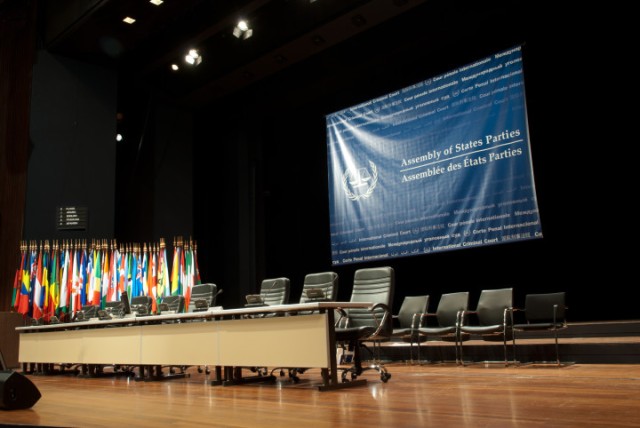
(Photo: K. Tjart / The Hague Institute for Global Justice)
Mr. President, distinguished delegates, ladies and gentlemen:
When I received news of South Africa’s intention to withdraw from the Rome Statute, like all other people who have dedicated their lives to the fight for human dignity and accountability around the world, I was deeply saddened.
I also remembered an incident that occurred during the negotiations that led to majority rule in South Africa, held at Kempton Park, Johannesburg. The then State President F.W. De Klerk had made some remarks that greatly offended Nelson Mandela. In fact, I have never seen Mandela so angry in public. But what was Mandela’s response to De Klerk? He did not storm out of the hall; he stood and walked majestically to the podium and confronted De Klerk firmly and honestly. That is the African way: We do not withdraw and walk away; we stay and we respond.
Mr. President, there have been long-running allegations that the International Criminal Court targets Africa. These allegations have often been met by recounting statistical evidence to the contrary, by recalling that most of the African cases at the ICC were referred to the Court by African states themselves. But I would like to respond here by giving another statistic. As of August 2016, there were 16 UN Peacekeeping Missions around the world. 9 of these are in Africa. This comprises 56% of all missions. We know that Africa does not make up 56% of the global population, but I have never heard anyone claiming that the UN is targeting Africa. Could it be that the like the UN, the ICC is most active where it is most needed?
We all know from recent history that the need for post-conflict justice is self-evident. Where there is no accountability, where warlords fighting for power know that they will not be held to account, there is no motivation to end conflict. And if there is a pause in the fighting, without justice, the ensuing peace is ever only temporary. This was amply demonstrated in Sierra Leone where the Lomé Peace Agreement of July 1999 included a blanket amnesty for combatants. It was just a matter of time before fighting resumed. When accountability was introduced into the equation through the establishment of the Special Court for Sierra Leone, sustainable peace was assured and continues to hold to this day.
Part of the grievance by African states against the ICC flows from a deeper pathology of governance in Africa where what is regarded as bad for the leader of a particular country is automatically assumed to be bad for the entire state. It also flows from a narrow and outdated definition of sovereignty that dictates that states should be left to mind their own business no matter how the decide to do so. But sovereignty is not a blank cheque nor can sovereignty mean that African states – whether governments or warlords – should be free to brutalise, murder, rape and loot from their own people in pursuit of power and resources without consequence.
The AU political leadership regularly complains about the role of the ICC in Africa. But these conversations are held behind closed doors in Addis Ababa and in other African capitals. Spaces where civil society and the press, let alone ordinary citizens, have to struggle to gain access. The tone of the communiqués that are issued after the AU summits make it clear that the leaders are speaking from their own perspectives. But who speaks for the victims?
The ICC is our court, created through the demand and with overwhelming support of African states, governments and civil society alike, to try to overcome their own legacies of massive human rights violations, including apartheid, genocide and multiple civil conflicts. It is time to tell those who complain that the Court is targeting Africa that the true position is that it is rather African victims who are accessing their Court in pursuit of justice. This is especially true when we remember that the ICC is a court of last resort which only intervenes where states are either unwilling or unable to investigate and prosecute serious crimes according to the principle of complementarity. There is a simple answer to African states that feel ‘targeted’ by the ICC to address the situation: Prosecute atrocity crimes occurring in your territories or committed by your nationals and deliver justice to the victims at home.
But this said, ICC is not a perfect institution. We should also remember that the Court is a small island of law that exists in a vast sea of politics. And as with all islands, sometimes the tide rises and the storms blow and the waves of politics come crashing onto the shores of the law and this clearly presents some challenges. There are three notable examples this:
First is the role of UN Security Council in referring cases to the ICC and deferring ongoing cases. 3 of the 5 permanent members of the Security Council are not members of the Rome Statute and yet they have the power under the Rome Statute to refer other states, including non-members, to the ICC as they have done with Sudan and Libya. This is clearly problematic. The situation is exacerbated by the fact some members of the Security Council have used their veto power to prevent serious crimes taking place in countries such as Syria from being investigated by the ICC. This blatant display of double standards that sacrifices the demand for justice at the altar of geo-strategic interests of the great powers can only hurt the global fight against impunity.
Second, there have been differing interpretations of the role of Head of State immunity in the Rome Statute system. While Article 27 of the Rome Statute is clear that official capacity as a Head of State or Government, a member of a Government or parliament, an elected representative or a government official shall in no case exempt a person from criminal responsibility, some have argued that this contradicts Article 98 which seems to recognize head of state immunity under international law.
Second, there have been differing interpretations of the role of Head of State immunity in the Rome Statute system. While Article 27 of the Rome Statute is clear that official capacity as a Head of State or Government, a member of a Government or parliament, an elected representative or a government official shall in no case exempt a person from criminal responsibility, some have argued that this contradicts Article 98 which seems to recognize head of state immunity under international law.
Third, there is the alleged targeting of Africa and the perception of bias against African countries that I have already discussed above and will return to in a moment.
How can these challenges be addressed in a meaningful way that leads to the strengthening rather than the weakening of the Rome Statute system and the International Criminal Court?
While the complaint against the role of the UN Security Council is legitimate, it is usually misplaced. Failure to refer situations such as Syria while referring those in Sudan and Libya are not the fault of the ICC. They are a result of imbalance in global power relations and the maintenance in place of an outdated global peace and security architecture inherited from the post WW2 arrangement.
There is need to revive and continue the debate on UN Security Council reform in order to make UN decision-making more reflective of the realities of the 21st Century. African countries need to direct their firepower at the real source of the problem; at the UN, not the ICC. We don’t treat a brain tumor by amputating a leg! The 3 members of the P5 must also continue to be encouraged to join Rome Statute in order to make the ICC a truly global mechanism for pursuing justice for victims of serious crimes.
On Head of State immunity, it is a cardinal principle of international criminal justice since Nuremberg that there cannot be immunity for persons who commit atrocity crimes. To grant them immunity would defeat the whole purpose of the system that has been painstakingly put together to ensure that there is accountability for crimes that shock the conscience of humanity. However, a conclusive interpretation of the Rome Statute on the issue of immunity needs to be sought by way of an advisory opinion from the International Court of Justice. This will clarify the law and place the pursuit of accountability on a firm footing. I am grateful to my friend Allan Ngari of the Institute of Security Studies for drawing my attention to this point.
On the perceived focus on Africa by the ICC, the Court needs to expand its scope beyond Africa and address violations wherever they occur in countries within its jurisdiction. While recognizing that each situation is unique, the Court also needs to demonstrate that it treats all countries equally. In this regard, it has been difficult to explain why a country such as Colombia has been under preliminary examination for 12 years, while the Court moves much faster in opening investigations in other situations. I am not suggesting that the court open investigations elsewhere for the mere purpose of filling a quota or demonstrating impartiality. I am saying that when one looks at the conflict map around the world, one clearly sees that it extends to parts beyond Africa and the Court’s reach needs to mirror that map.
In conclusion, Mr. President, I wish to end where I began, with the image of Nelson Mandela walking majestically to the podium at Kempton Park when he could have stormed out of the room. The ICC is not just struggling under the weight of a legacy of impunity on our continent; it is also struggling under the weight of history. There are strong sentiments among African peoples driven by legacies of racism, domination and exclusion. These sentiments are real and they cannot, and should not be wished away. Like Mandela, all Africans in this room have at one point or another in our lives been insulted, discriminated against or victimized because of the colour of our skin. But when this has happened, when we have felt unfairly treated, we have not walked away from the problem, we have confronted it. We have been part of the solution to the myriad challenges confronting us as members of the human family and in so doing, we have often shown others the way.
All African ICC member states must do the same. They must work within the Rome Statute structures to improve an International Criminal Court that is needed more desperately now than when it was first created.
I thank you.
Tuesday, 2 January 2018
Bravery propels Njonjo Mue to great heights as crusader
I have read many articles written about me by the media in the past, but none has been as accurate and fair as this profile, Bravery propels Njonjo Mue to great heights as crusader, written by John Kamau in the Daily Nation of 7 November 2017.
BRAVERY PROPELS NJONJO MUE TO GREAT HEIGHTS AS CRUSADER
BY JOHN KAMAU
Njonjo Mue is not the typical human rights activist: He is brilliant, hardly screams and speaks methodically.
Born in Thika, Mr Mue came to the attention of the media in 1997 when he joined many other activists at Uhuru Park to demand for a new constitution ahead of the elections.
As police tear-gassed everyone, one man was left kneeling down – praying and singing the National Anthem: The man was Njonjo Mue.
REFORMS
The bravery of Mr Mue caught the attention of photographers and his picture became the source of inspiration to those confronting the Moi administration and demanding free electoral atmosphere.
The bravery of Mr Mue caught the attention of photographers and his picture became the source of inspiration to those confronting the Moi administration and demanding free electoral atmosphere.
Mr Mue was part of the group that coined ‘No Reforms, No Elections” phrase in 1997 when opposition MPs decided to side with Moi and agreed to carry out minimum reforms against the wishes of the civil society groups, which were pushing to an overhaul of the Constitution.
A former ‘A’ student at Alliance High School – where he was an actor and sang in the choir - Mr Mue studied law at the University of Nairobi and later at Oxford University where he was a Rhodes Scholar and did Bachelor of Civil Law.
LEGAL ADVISOR
He also studied for a Master's in international law and comparative human rights.
On his LinkedIn page, Mr Mue says that he was “prevented from graduating due to illness”.
Before he came back to Kenya, Mr Mue worked with Article 19 as the legal advisor to the African programme based in South Africa.
It was during this period that he was named Jurist of the Year 2000, becoming the youngest recipient of the award. He was 33.
Mr Mue was later employed as Regional Director with Panos Eastern Africa based in Uganda up to 2002 – before starting work as head of advocacy with the government-funded Kenya National Commission on Human Rights, which was chaired by his ally, Maina Kiai.
ACTIVISM
It was his epic speech during the Jurist of the Year ceremony that captured attention of everyone present as he sought solutions to the national issues.
It was his epic speech during the Jurist of the Year ceremony that captured attention of everyone present as he sought solutions to the national issues.
“First, we must robustly embark upon the task of organising the unorganised.
"I was once led to believe that the role of education was to enable us to speak for the voiceless; but I have since come to know that the best people to speak for the voiceless are the voiceless themselves,” he said.
Mr Mue has a driving philosophy and which he clearly elucidated:
“The human rights movement has tended to be selective in choosing the issues to articulate, partly based on convenience and practical considerations.
"But we cannot choose our battles only because they can be won. We must choose our battles because they must be fought”.
ARREST
He is the man who in 2004 scaled the walls of Parliament and took away a pennant flag off a cabinet minister’s limousine to symbolically demonstrate the government’s loss of moral authority to govern after the Anglo-leasing scandals and decision by MPs to increase their salaries.
He is the man who in 2004 scaled the walls of Parliament and took away a pennant flag off a cabinet minister’s limousine to symbolically demonstrate the government’s loss of moral authority to govern after the Anglo-leasing scandals and decision by MPs to increase their salaries.
He was also said to have slapped an assistant minister in the process before he was arrested and charged with creating disturbance.
At the court, he got more attention when he stood and sang the whole national anthem and the magistrate asked the orderlies to let him finish the song.
INSANITY TEST
But when the magistrate ordered that he be subjected to psychiatric test, Mr Mue sought to address the court:
“If in Kenya today it is considered normal for ministers to drive vehicles worth Sh10 million while a family of six in Kibera subsists on Sh40 a day, then you don’t have to ask a psychiatrist, I will tell you myself for free, I am mad;
If it is considered normal for MPs to be taken to Mombasa on holidays by BAT to be bribed to block tobacco control legislation while our people continue dying of tobacco related ailments, then I am mad;
If it is normal for our leaders to traverse the land hurling insults at each other while our people are robbed, raped and murdered, then I am mad;
And I take comfort in the fact that I am not the only one, we are millions of mad people who do not want to act normal while watching our country going to the dogs.
As for the charge before you, your honour, I beseech you not only to find me guilty, but to hand down the harshest sentence permitted by the law.”
ELECTION
A day before he filed the presidential petition, Mr Mue had posted the same thought on his Facebook page:
“We should pick our fights not just because they can be won, but because they must be fought.”
Besides his life as a human rights crusader, Mr Mue is also a trained theologian and did an MA at the Nairobi International School of Theology majoring in the Theology of Social Involvement, Christian Ministry and Leadership.
He wrote his MA Thesis on the topic “Forgiveness in Politics: Reflections on Truth, Justice and Reconciliation in Kenya.”
Friday, 13 October 2017
WHITHER ARE WE BOUND: DEMOCRACY OR DICTATORSHIP?
SPEECH
BY NJONJO MUE, CHAIRMAN OF ICJ - KENYA DURING THE CIVIL SOCIETY FORUM ON
DEMYSTIFYING THE SUPREME COURT JUDGMENT AND THE ROLE OF THE JUDICIARY IN
ELECTORAL DISPUTE RESOLUTION.
PANAFRIC
HOTEL, 13 OCTOBER 2017
I am delighted to welcome you to this forum
that seeks to provide a platform for civil society to interrogate and shed
light on the substance, meaning and implications of the Supreme Court judgment that
nullified the August 8th Presidential election and ordered a repeat
within 60 days.
This discussion is taking place against the
backdrop of alarming developments on the political front that have caused grave
concern to all who care about the future of our democracy.
One of the two main candidates at whose
behest the August election was nullified has withdrawn from the race citing an
uneven playing field, while the other has decided to push through controversial
amendments to the election laws in a move that seems calculated to circumvent
the Supreme Court judgment and fundamentally change the design of the Independent
Election and Boundaries Commission (IEBC) ahead of the repeat elections. As the
country hurtles towards a precipice, we the citizens have been relegated to the
role of spectators.
In June this year, Jubilee Vice Chair and
close confidant of President Uhuru Kenyatta warned in an interview with KTN
News that we should prepare for a more lethal, brutal and ruthless Uhuru
Kenyatta during his second term in office. He went on to say that we would see
the President in “his true colours,” and that he would “nyorosha this place”
with “gloves off” and “bare knuckles”. He also said that the Constitution would
be amended to give “back the President power to make executive orders.” More
recently, Murathe has hit the airwaves once again arguing that Kenya needs a
benevolent dictator.
In light of these worrying remarks, the
question that arises is this, are we witnessing the slow overthrow of our
Constitution and the establishment of a dictatorship?
Consider this:
Consider this:
Recently, we have seen university students beaten,
tortured, and raped by police officers who forcibly removed them from their
lecture rooms and halls of residence in order to terrorise them. No one has
been held to account. We have witnessed the naked intimidation of the Judiciary
and threats directed at judges following the nullification of the August
elections with ominous promises by the President to ‘re-visit’ and ‘fix’ the
Judiciary if re-elected. We have also seen the passing of amendments to
election laws whose sole purpose appears to be to circumvent the Supreme Court
judgment. And only yesterday, the Cabinet Secretary for Interior issued a
statement purporting to arbitrarily ban public demonstrations in violation of
the clear provisions of the Constitution.
All this goes to show that the dictatorship
that Murathe promised and continues to campaign for is already here; it’s just
not that benevolent!
For dictatorships are the ones that
brutalise young people seemingly without consequence. Dictatorships are the
ones that instrumentalise parliaments and intimidate Judiciaries. Dictatorships
are the ones that change laws to suit their short-term desires. And dictatorships
are the ones that outlaw public expressions of dissent at a whim.
ICJ Kenya has had a long history of
involvement in Kenya’s Constitution making process. In 1994, we co-authored, together
with the Law Society of Kenya and the Kenya Human Rights Commission, the first
model constitution titled ‘Kenya Tuitakayo’ which offered a vision of the new
Kenya we were yearning for as a country to replace the Lancaster House
Constitution. In 1997, we were played a
key part in the National Convention Assembly and we worked with others
in boardrooms and in street demonstrations that pushed the Moi state to agree
to minimum reforms through the Inter-Party Parliamentary Group (IPPG). We were
also involved in all the processes leading up to the promulgation of the
Constitution of Kenya 2010.
As a community of jurists, we endeavour to
be politically non-partisan. But we are unapologetically biased towards democracy,
human rights and the rule of law. We therefore have a responsibility to defend
our Constitution whenever it comes under threat. And in this critical moment, history is
summoning us one more time to take a stand.
In this context, what is the meaning and
character of the planned October 26 repeat election?
If the ruling party goes ahead with its
plan to circumvent the Supreme Court judgment, reintroduce the discredited
manual system of result transmission, and fundamentally alter the design of the
IEBC to suit its own ends, then the period between now and 26th
October and beyond will mark another watershed for Kenya’s history. We will be
faced with a decision whether to agree to rubberstamp a coronation in the name
of an election or whether to take a stand to defend our democracy.
Each nation has in its history a list of
sacred days. In the case of Kenya, our sacred days are February 18, 1957;
December 12, 1963; 7 July 1990; 27 August 2010 and 1 September 2017. As we approached each of these days, we did
so with a mixture of anxiety and fear, but also with hope and expectation. But as we look back to them with the benefit of hindsight, we recognise them as the moments when the old began to give way to the new. In the same way, if
our politicians do not step back from the brink and rise up and lead our country out of the
current crisis, 26 October 2017 is likely to join this list of our sacred days.
For it will be the day that Kenyans will
decide whether to submit to David Murathe’s dictatorship or to take a stand and
defend their freedom.
Speaking to the children of Israel in the
early days of their nationhood, their leader, Joshua, challenged them in these
timeless words: “Choose this day whom you shall serve, whether the gods your
ancestors served or the gods of the Amorites. But as for me and my house, we
will serve the Lord.”
In the same way, the time is coming and will soon be upon us when the Kenyan people must choose whether they will serve the gods of the old
order that seems to be determined to re-establish itself or whether they will
stand up and defend their Constitution.
And so, as we deliberate this morning on the substance,
meaning and implications of the Supreme Court judgment, let us do so in the full
knowledge that it has the potential to strengthen our democracy if we let it,
or to be used by the political establishment as an excuse to inaugurate a
dictatorship if we allow them.
Amkeni ndugu zetu!
I thank you.
Tuesday, 4 July 2017
OF CHICKENGATE, AMBULANCES AND THE EMPEROR'S NEW SUIT...
So, here's the thing. In 2015, a British court successfully prosecuted Smith & Ouzman Ltd. and two of its directors for bribing our election officials to obtain contracts for printing of election materials. The two directors were jailed and the company was fined.
Ahead of the sentencing in Britain we, Kenyans for Peace with Truth and Justice (KPTJ), wrote to the Serious Fraud Office providing some context with regard to the serious damage done to any young democracy when its electoral institutions are undermined through this kind of corruption. We also argued that any fines levied on the company should be sent to Kenya as the Kenyan people were the ultimate victims of this crime.
Ahead of the confiscation hearing at which the company's fine was to be assessed, we wrote to the AG asking him to apply to be enjoined in the proceedings to canvass Kenya's public interest and to specifically make the case for the money to be sent back home to Kenya. He ignored our letter. We also wrote to the IEBC seeking to know what steps it was taking to recover the money that had been stolen from it through inflated prices for the election materials printed by Smith & Ouzman, but again we did not get a response.
A few days before the confiscation hearing, we travelled to London and met with the SFO to further argue our case for restitution. In all our letters and meetings, we insisted that the money should be given to a cause that would benefit the Kenyan people and not merely returned to IEBC where it might be stolen again.
In the meantime, the Kenyan government would not prosecute the officials implicated in the Chickengate scandal, notably the then IEBC Chair Issack Hassan and the then Energy Secretary Davis Chirchir. Instead, it maintained a studious silence even as the UK justice system did its work with speed and alacrity. Only rather belatedly was former IEBC CEO Oswago charged.
Fast-forward to yesterday and the President is reported and pictured heartily launching ambulances bought with the proceeds of the Chickengate scandal without any sense of irony. This is especially telling given that the alleged masterminds of the Chickengate scandal continue to walk free and billions of shillings have since been reported stolen from the health budget with members of the President's own family having been adversely mentioned.
But the media reports of the President launching the ambulances dare not point out that our emperor has no clothes.
Subscribe to:
Posts (Atom)